

Drivers Take the Wheel: How the IAM is Helping Illinois Rideshare Drivers Build Their Union
This article was featured in the Winter 2026-2027 IAM Journal and was written by IAM Communications Representative Angela Colaizzi
For rideshare drivers, pay can shift overnight. Major safety concerns are swept under the rug. Drivers can be deactivated from the apps they rely on for income with no explanation or recourse.
For years, they’ve kept America moving. They pick up passengers before sunrise, navigate rush-hour traffic, work overnight shifts, sleep in their cars to make ends meet, and provide necessary transportation to millions of people everyday. Despite taking on all of the risk and responsibility of powering a multibillion-dollar industry, they haven’t gotten the respect they deserve or had a voice in their work… until now.
Rather than accepting their tough working conditions as the cost of doing business, rideshare drivers are organizing. With the support of IAM Union and its partners, they are changing what was thought possible for this industry and unionizing.
TURNING FRUSTRATION INTO ACTION
“I never thought we would do this. It’s actually crazy. I talk about it with my counterparts, and we’re in almost disbelief. We were a dozen friends who would chip in twenty bucks each a week to print flyers and make T-shirts.”
That’s IAM Associate Organizer Lenny Sanchez talking about how it started years ago: a bunch of friends working on the rideshare apps who knew they deserved better and decided to take a stand for it.
“I went through what I think is the typical experience for drivers,” said Sanchez. “There is a honeymoon phase when you first sign up to drive. That’s when the apps will hook you up with the highest tipping passengers and the best promotions to get you hooked. Then, they pull the rug out from under you, and you quickly start to realize what working for this app long term is going to look like.”
“The pay starts to dwindle and the treatment is as cruel and heartless as it gets,” said Sanchez.
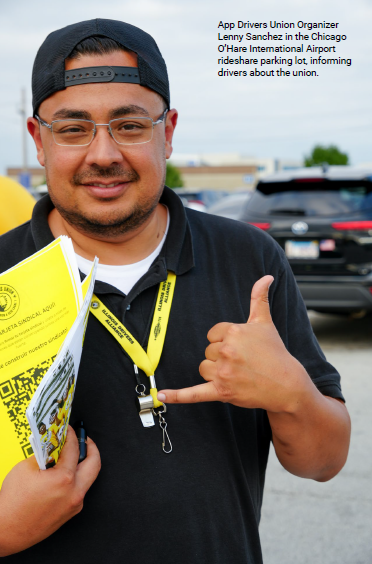 Sanchez had a passenger pull a firearm on him and kidnap him at gunpoint. Upon completion of the ride and trying to get a resolution, the companies would not cooperate so that the crime could be investigated by law enforcement. Their solution was to never pair him with that passenger again. “I realized that I was nothing more than a number, and they were willing to allow that same passenger who held a gun to my head in another drivers’ car.”
In the beginning of rideshare apps’ existence, drivers’ contracts stipulated a fixed percent commission that they were going to get from every single ride, but the apps sneakily made a change to their terms and conditions, and with the implementation of dynamic pricing, companies take a much larger chunk of the fares, while drivers receive a much smaller fixed dollar bonus or nothing. Surcharges on high-demand areas and for access to airports raise prices for customers, but drivers don’t get paid more for driving during congestion or in certain areas.
Drivers describe unpredictable earnings, declining compensation, rising operating costs, safety concerns, and the constant uncertainty of working for algorithms that change without notice.
Andrew Spiro started driving after retiring to help pay bills and support his family. “I took pride in my work and maintained an excellent passenger rating, but that didn’t stop me from being suddenly deactivated without warning or a meaningful explanation. I never had the chance to speak with a real person or defend myself. An algorithm simply decided my livelihood was gone. No driver should have to live with that kind of uncertainty,” said Spiro.
“What I used to make in 15 to 20 hours a week, I am now working 35 to 45 hours a week and not even touching that, “ says rideshare driver Lisa McGee. “I was never one of those 10 to 12 or 14-hour-day drivers. The most I would do is maybe six to nine, depending what’s going on. But, now I have to in order to make the same or less. Our promos are terrible. The last three weekends, my promo was twenty rides for ten bucks. Ten dollars? Gas is four-something a gallon! How do they work that out?”
Mark Balentine was a worker protection organizer at Warehouse Workers for Justice before he became a driver for Uber. He got involved with the campaign when he was denied payment for a “quest” Uber promoted to increase ride sales.
The deal was, drivers would get $1,800 for completing 140 rides within a month’s time frame, a 30-day window. For example, if the driver completed 140 rides that accounted for $1,200 of earnings, Uber guaranteed to pay out the $600 remainder. Balentine completed more than 140 rides in 30 days; he even got a notification on the app telling him when he reached 140, but Uber’s system had a glitch and they refused to look at his screenshots for proof, so he was denied the payout.
“They just messed with the wrong organizer,”
said Balentine. “I’ll get my money back from Uber one way or the other, and ever since then, I’ve been locked in on this union. I’ve been with Uber since 2014, and that’s the third time they ever did something that I felt was unjust, the first two I let slide, but the third lit a match up under me.”
Those shared experiences became the foundation of the Illinois Drivers Alliance, a coalition led by the IAM Union and SEIU Local 1 established to bring drivers together from every corner of the state and pressure lawmakers for their right to organize in a union.
A HISTORIC VICTORY IN ILLINOIS
The IAM fully committed to the effort, pulling in IAM Midwest Territory International Representative Ronnie Gonzalez to take the lead, organizing drivers for press conferences and rallies and guiding them in sharing testimony with lawmakers, working with allies and fellow unions, and most importantly lobbying politicians for drivers’ right to unionize.
IAM International President Brian Bryant and IAM Midwest Territory General Vice President Sam Cicinelli supported the effort whole-heartedly. Cicinelli had led the early stages of the campaign before turning it over to Gonzalez. Bryant and Cicinelli both invested in the goal. There are 100,000 rideshare drivers in Illinois, and in order to organize them, a law had to be passed first. IAM Railroad Coordinator Brian Shanahan was also brought into the effort for his knowledge of Illinois public transportation and his connections through representing transit workers.
As it stood, rideshare drivers were classified as independent contractors, not employees of Uber and Lyft. That classification barred them from organizing under federal rules, meaning a specific state-level legal framework was required to authorize collective bargaining.
Gonzalez and Shanahan helped build that framework with SEIU Local 1 and collaborated with ATU’s Clem Balanoff, Mid-America Carpenters’ Political Director Matt Watchinski, the Illinois Nurses Association’s Margo Gislain, SMART’s Political Director Bob Guy, and the Illinois AFL-CIO to advocate on behalf of the bill they drafted: the Rideshare Drivers Union Rights Bill (or the Transportation Network Driver Labor Relations Act).
The IAM team coordinated closely with SEIU Local 1, as well as IAM leadership and staff. They formed an organizing committee and held weekly meetings to develop communication and political strategy to support the drivers and get the bill passed.
Gonzalez, Sanchez and Balentine worked alongside drivers every step of the way. They organized lobby days, and drivers from all over Illinois would travel to Springfield to speak with their state legislators and share their personal stories for why they need a voice in their work.
“The legislative process was its own beast,” said Gonzalez. “Going down to Springfield on a regular basis. We brought drivers down there every single Wednesday and circulated them throughout the legislators. The drivers met directly with the legislators and informed them of the circumstances that they faced, and I think that had a huge impact on the legislators when it came time for them to push the button yes or no in the vote, because hearing the stories directly from the drivers is really moving.”
All of it paid off at 2 a.m. on June 1, 2026 when the Illinois General Assembly passed House Bill 5090, the Transportation Network Driver Labor Relations Act, to grant approximately 100,000 rideshare drivers the right to unionize, elect representatives, and collectively bargain with companies like Uber and Lyft.
“One of the most exciting points of it is, we were the only labor bill to pass out of Springfield in this session, that speaks volumes to the campaign. We also did it in one legislative session, which in Illinois, not many laws do it that way. It just shows the amount of grit that everybody put in and the time spent,” said Gonzalez, reflecting on the year-long effort.
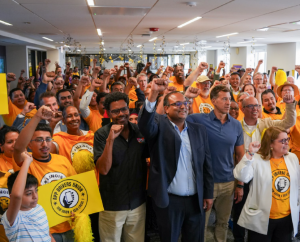
Drivers celebrating the passage and signing of the Rideshare Drivers Union. Rights Bill. Center: State Senator Ram Villivalam, Rideshare Drivers Union Rights Bill Chief Co-Sponsor.
On August 7, 2026, Illinois Governor JB Pritzker signed the bill into law, followed by a huge celebration of rideshare drivers who had lobbied for a year to get the legislation.
The next chapter is about building a strong union, engaging drivers across Illinois to sign up, and preparing to negotiate meaningful improvements to address pay, safety, transparency, and job security.
“Now the work starts,” said Balentine. “We celebrated. We kicked-back for a minute, but now we’ve got to make this work. I’m doing whatever I’ve got to do to make sure this union works. When I see that we have 30,000 drivers and we get a bargaining team together and send them to that table, I might take my foot off the gas.”
BUILDING ON MOMENTUM IN MASSACHUSETTS
Nearly 1,000 miles away, another groundbreaking campaign has shown what workers can accomplish when they organize together.
In Massachusetts, the IAM Union partnered with SEIU 32BJ to help create the App Drivers Union, giving nearly 70,000 app-based drivers a recognized voice on the job and opening the door to collective bargaining.
While the legal paths for these victories differed between the two states, the mission remained: ensuring that app-based workers have the opportunity to stand together and negotiate for better wages, stronger protections, and greater respect.
The Illinois Drivers Alliance adopted the App Drivers Union title after their bill was passed, gearing up to organize drivers now that they can legally be in a union. ■
App Drivers Union Organizer Lenny Sanchez in the Chicago O’Hare International Airport rideshare parking lot, informing drivers about the union.
Left: Drivers celebrating the passage and signing of the Rideshare Drivers Union Rights Bill. Center: State Senator Ram Villivalam, Rideshare Drivers Union Rights Bill Chief Co-Sponsor.
Legal Disclaimer:
EIN Presswire provides this news content "as is" without warranty of any kind. We do not accept any responsibility or liability for the accuracy, content, images, videos, licenses, completeness, legality, or reliability of the information contained in this article. If you have any complaints or copyright issues related to this article, kindly contact the author above.
